Category: Uncategorized

  • How to Print on Bamboo Shirts: Screen, DTG, DTF and Embroidery Compared

    How to Print on Bamboo Shirts: Screen, DTG, DTF and Embroidery Compared

    The label may say bamboo, but the printer sees rayon. Almost every soft bamboo tee on the market is bamboo viscose, a cellulosic fiber regenerated from bamboo pulp. That single fact drives every decoration decision that follows, because viscose is more heat-sensitive than cotton and far more delicate than polyester. Choose a method that ignores this and you get scorched sheen, a stiff hand on a fabric people buy for its softness, or a print that cracks after a dozen washes. This guide compares the four decoration methods you will actually be quoted on, with the temperature and durability details that separate a good result from a reprint.

    Start with the fiber, not the ink

    Bamboo viscose jersey typically lands between 140 and 180 grams per square meter, lighter and drapier than a standard 180 gsm cotton tee. It behaves like a semi-synthetic cellulose: it takes water-based color well, but it softens and glazes under heat that cotton would shrug off. Decorators repeatedly warn that viscose can develop a permanent shiny or scorched patch at high press temperatures, and that it shrinks if it meets hot water or a hot dryer. Two consequences follow. First, whatever method you pick has to work at the lowest reliable temperature. Second, the finished garment needs a cold-wash, low-heat care instruction, and it is worth printing that on the label so your customer does not undo your work in the laundry.

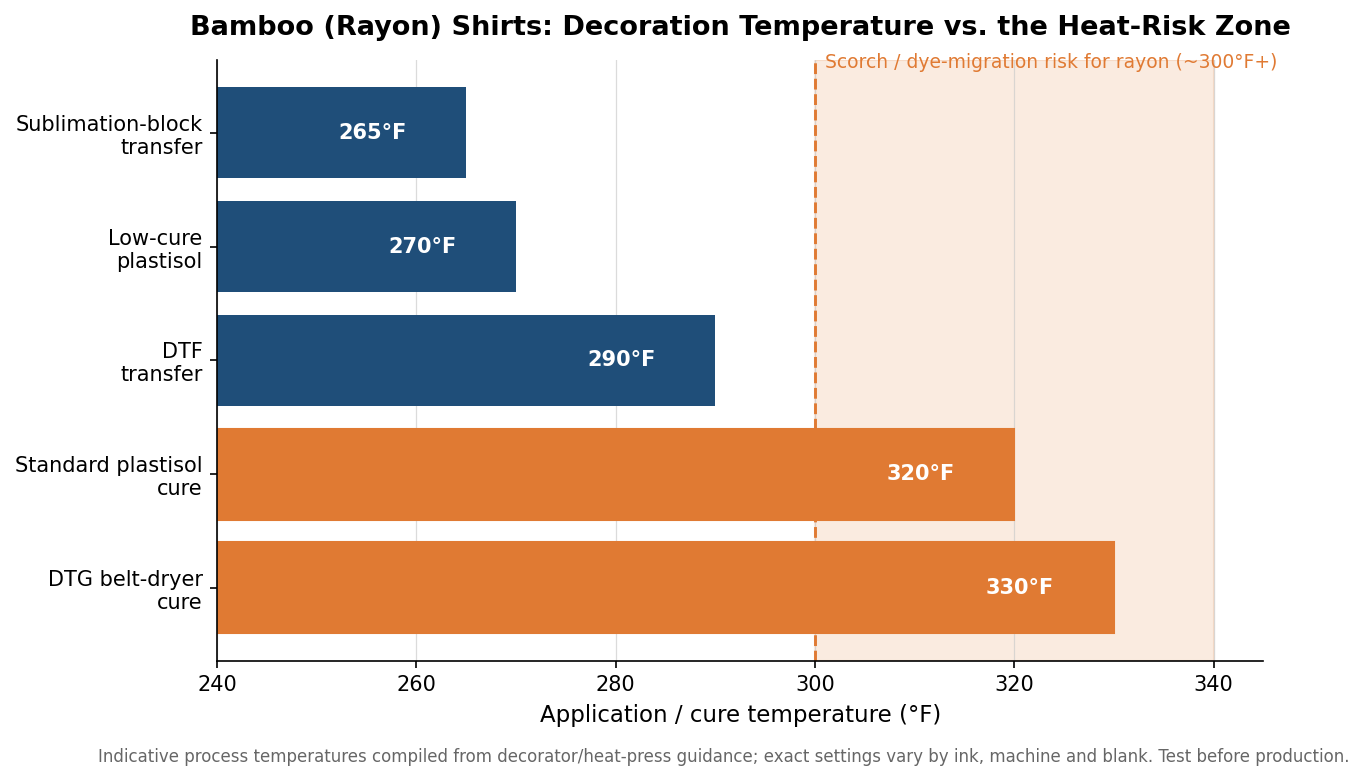
    The chart below places the common decoration processes against the zone where rayon starts to get into trouble. Anything pushing past roughly 300°F is where dye migration and surface glazing become real risks on a viscose blank.
    Horizontal bar chart of decoration temperatures for bamboo rayon shirts against the ~300F scorch and dye-migration risk zone
    Low-cure plastisol and DTF stay below rayon’s heat-risk zone; standard plastisol and DTG cure temperatures push into it.

    Screen printing: the most durable print, if you control the cure

    For a simple one- to three-color logo in volume, screen printing still gives the toughest, longest-lasting result. A properly cured plastisol print routinely survives 50 or more wash cycles with minimal fade. The catch is the cure: standard plastisol needs its whole ink film to reach about 320°F to fully cross-link, and that is right in the rayon danger band. The fix is a low-cure plastisol formulated to fuse near 270°F, which keeps the fabric well under its scorch threshold while still curing hard. Ask your decorator specifically whether they are running a low-cure ink and verifying it with a temperature gun or test strip rather than eyeballing the belt.

    Watch dye migration on colored blanks. Deep reds, maroons and some blues carry disperse-type dyes that can reactivate and bleed up into a light print once the ink film climbs above roughly 300°F, leaving a white logo looking pink days later. On darker bamboo garments, a low-bleed or blocker-based ink and the lowest workable cure temperature are the practical defenses. Also be realistic about water-based and discharge inks: discharge relies on bleaching the garment dye and is engineered around reactive-dyed cotton, so it is unreliable on viscose and often will not discharge cleanly. Standard water-based inks can work but need careful curing to avoid under-cure on this fiber.

    DTG and DTF: full color and short runs without a screen

    Direct-to-garment printing suits bamboo well on the fiber side, because viscose is cellulose and accepts water-based DTG ink much as cotton does. The tradeoffs are the usual ones: DTG shines for photographic or many-color art and for one-off and small orders, but the print sits softer and generally fades sooner than screen print, and dark garments need a pretreat and a heat-cure step you must keep brief and shielded so the platen heat does not glaze the fabric.

    Direct-to-film transfers have become the flexible workhorse for tricky fabrics because they apply at a lower temperature than most cotton settings. Practical viscose press guidance runs about 280 to 300°F for 10 to 15 seconds at medium pressure, with a 3 to 5 second pre-press to drive off moisture and a Teflon or parchment sheet over the transfer. If the fabric picks up an unwanted sheen, drop the temperature 10 to 20°F and shorten the dwell. DTF gives you full color with no screens, holds up well when applied correctly, and lands in a sweet spot for short-to-medium runs, though the print is a film sitting on the surface rather than in the cloth, so hand feel is firmer than a good water-based print.

    Embroidery, and the method that simply will not work

    Sublimation is off the table for true bamboo viscose. Dye sublimation bonds only to polyester, so on a cellulosic bamboo shirt the gas-phase dye has nothing to bind to and the image washes out. If someone quotes you all-over sublimation on a 100% bamboo tee, that is a red flag worth questioning. Embroidery, by contrast, works on any fiber, but lightweight bamboo jersey is thin and drapey, so it puckers easily. It needs a cutaway backing, a slightly looser stitch density, and it is far happier on heavier bamboo pieces such as polos, French terry or caps than on a featherweight 150 gsm tee. Embroidery reads as premium and is effectively permanent, but it adds bulk and is priced by stitch count, so it fits logos rather than large or detailed art.

    Matching the method to your order

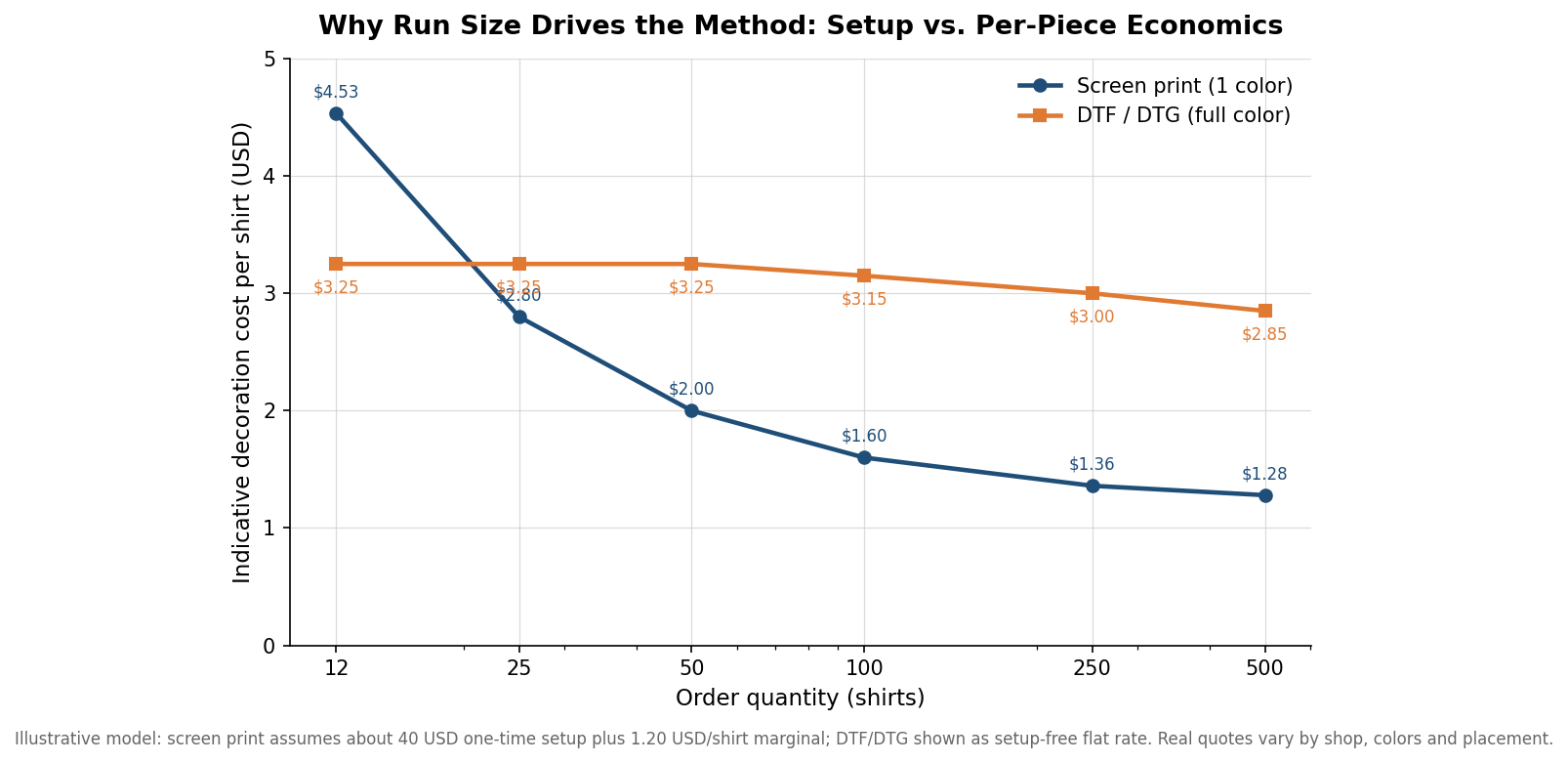
    Once the fabric constraints are handled, the decision usually comes down to color count and quantity. For one or two ink colors at higher volume, screen printing wins on both durability and unit cost. For full-color art, tiny runs, or frequent design changes, DTF or DTG avoids screen setup entirely. The economics are the clearest way to see the crossover: screen printing carries a one-time setup that gets cheaper per shirt as the run grows, while DTF and DTG stay close to a flat rate no matter how many you order.
    Line chart comparing indicative per-shirt decoration cost for screen printing versus DTF and DTG across order quantities
    Screen printing’s setup cost falls away with volume, crossing below flat-rate DTF/DTG at around 20 to 25 shirts.

    The indicative model above shows why a 12-piece order of a simple logo often prints more cheaply by DTF, while the same logo at 100 or 250 pieces is markedly cheaper by screen. Treat the exact dollar figures as illustrative; real quotes swing with color count, print size, garment cost and shop. The durable takeaways are structural. Confirm your shirt is bamboo viscose and specify a low-temperature process. For volume one-to-three color work, ask for low-cure plastisol and, on colored blanks, a low-bleed ink. For full color or short runs, DTF at roughly 290°F with a protective sheet is the safe default, and DTG is the softer option when hand feel matters most. Reserve embroidery for heavier pieces and logo-scale marks. Get a pressed and washed sample before committing to a production run, because on a fiber this heat-sensitive, a five-minute test wash is the cheapest insurance you can buy.
  • Why the White Print on Your Dark Shirts Turned Pink

    The shirts left perfect and the complaint arrived a month later. That timing is the clue, and it points at the dryer rather than at the press.

    What dye migration is

    Polyester is coloured with disperse dye, which turns to gas at cure temperatures.

    The gas passes into the ink film sitting on top of it and colours it from beneath.

    Why it shows up late

    The reaction continues gently after cure, especially in a warm carton.

    So a perfect shipment becomes a pink one somewhere between the dryer and the shelf.

    How it is prevented

    A low-bleed underbase blocks the migrating dye before it reaches the top colour.

    A lower cure temperature with a longer dwell reaches full cure with less sublimation.

    What to ask for

    Whether a low-bleed underbase is being used on every dark blend, as standard.

    And a wash-and-warm-storage test on the actual garment, not on a cotton sample.

  • Why Your Bamboo Shirt Is Legally Called Rayon

    The word on the label and the word in the sales pitch are allowed to differ, and knowing why protects you rather than the factory.

    How the fibre is actually made

    Bamboo is dissolved into a solution and spun back out as a cellulose filament.

    What comes out is chemically the same class of fibre as any other viscose.

    So the generic name applies

    US labelling asks for the generic fibre name: rayon made from bamboo, or viscose from bamboo.

    A garment labelled simply bamboo is mislabelled, however soft it feels.

    The claims attached to it

    Antibacterial and antimicrobial wording has drawn regulator action, because the plant’s chemistry does not survive the process that makes the fibre.

    Eco and organic wording needs a certificate behind it, not a marketing line.

    What to ask your supplier

    For the fibre content in writing, and for the exact wording that will appear on the label.

    If they cannot answer either question, the shirt is being sold to you on a word.

  • The Complete Buyer’s Guide to Custom Bamboo Shirts

    Bamboo shirts are sold on a word and bought on a feeling. Neither survives the reorder unless somebody writes the specification down.

    What fibre is it, really?

    Almost always viscose regenerated from bamboo, which is why the label must say so.

    Mechanically processed bast fibre exists, costs more, and feels like coarse linen.

    What is the blend ratio?

    More bamboo for hand feel, more cotton for stability and print range.

    A 70/30 and a 50/50 are different garments sold under the same three words.

    What is the knit weight?

    GSM decides opacity and drape. Pale colours in a light knit are where complaints start.

    Ask for the number rather than for the words light or midweight.

    How will it be printed?

    Soft-hand ink sinks in. A thick plastisol slab sits on top and cracks along the drape.

    On dark blends, insist on a low-bleed underbase or expect pink where white should be.

    And check the shrinkage allowance

    A viscose knit moves in a hot wash. Size the run against a stated allowance, not a hope.

  • Bamboo vs. Cotton T-Shirts: Choosing Blanks for Custom Printing

    Bamboo vs. Cotton T-Shirts: Choosing Blanks for Custom Printing

    Ordering custom shirts means choosing a blank before you choose a design, and the fabric decision quietly controls how the finished garment feels, how the print holds up, and how the shirts fit after a few washes. Bamboo-based tees have moved from novelty to mainstream, and buyers now weigh them directly against the cotton blanks that have dominated printing for decades. The two behave differently enough that the right choice depends on what you are printing, how the shirts will be worn, and how much you care about drape versus durability.

    What “bamboo fabric” actually means

    The word bamboo on a hangtag almost always describes a regenerated cellulose fiber rather than a fabric spun from bamboo stalks. Industry estimates put more than 80 percent of bamboo apparel in the bamboo viscose (rayon) category, made by dissolving bamboo pulp in a chemical bath and extruding it into filaments. The result is exceptionally soft, drapey, and highly absorbent, with excellent dye uptake. A more premium route is bamboo lyocell, produced in a closed-loop system that recovers roughly 99 percent of the solvent and yields better wet strength and less pilling. A third, far rarer version is mechanically processed bamboo linen, which crushes and enzyme-treats the stalk to produce a textured, linen-like cloth. For printing purposes, most of what you will handle is viscose or a viscose-cotton blend.

    One labeling detail is worth knowing before you market the shirts. In the United States, the Federal Trade Commission treats chemically regenerated bamboo as rayon and requires it to be labeled that way, typically as “rayon” or “rayon made from bamboo.” The agency has penalized retailers for calling the same fabric simply “bamboo” or for repeating unverified antibacterial and eco claims. If you resell printed bamboo tees, mirror the mill’s fiber content on your own listings rather than upgrading the language.

    Weight and feel: reading the GSM number

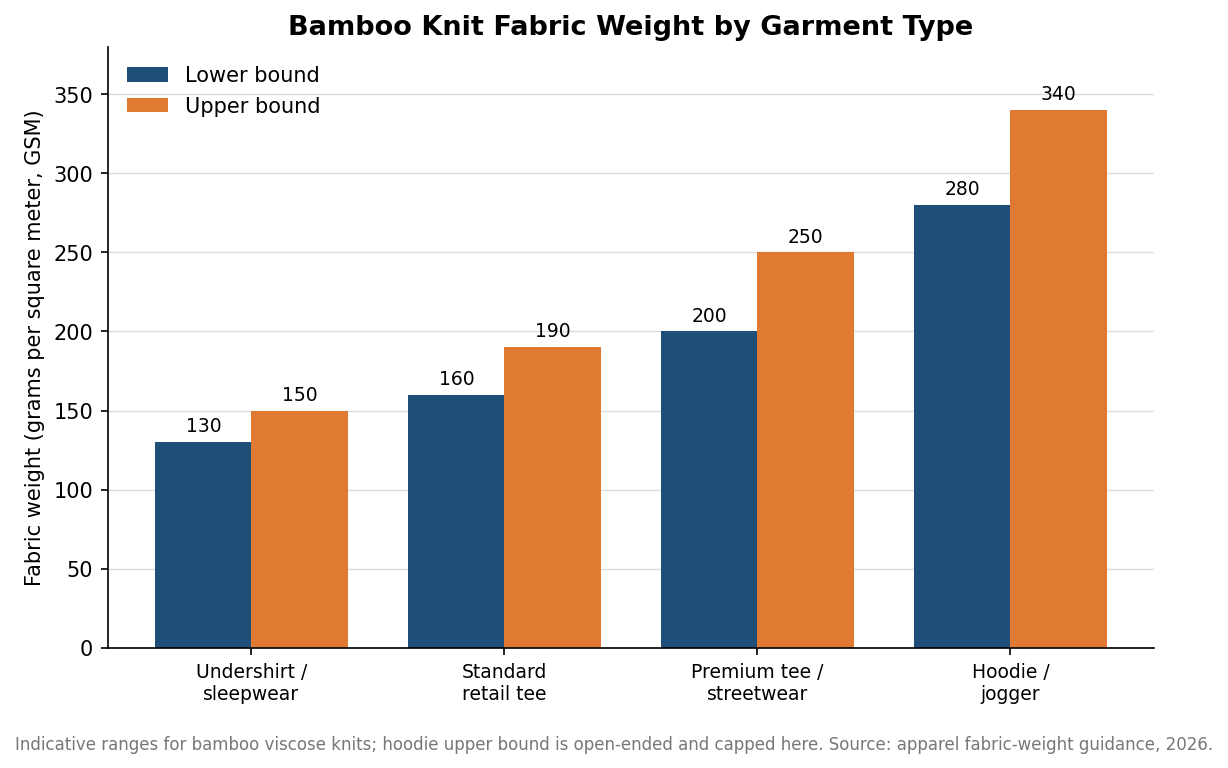
    Fabric weight, quoted in grams per square meter (GSM), tells you more about a shirt than the fiber name alone. Lightweight knits in the 130 to 150 GSM band suit undershirts and sleepwear but can feel thin and show print backing through the cloth. The sweet spot for a standard retail-quality tee sits around 160 to 190 GSM, heavy enough to feel substantial and to support a clean print, light enough to keep bamboo’s signature drape. Premium tees and streetwear push into 200 to 250 GSM, and anything at 280 GSM or above is really hoodie and jogger territory. Bamboo viscose reads softer and cooler than cotton at the same weight because the fiber is smoother and more absorbent, so a 180 GSM bamboo blend often feels lighter on the body than a 180 GSM all-cotton tee.

    Grouped bar chart of bamboo knit fabric weight in GSM by garment type, from undershirts at 130-150 to hoodies at 280 and above
    Fabric weight bands help match a bamboo blank to its intended use; standard tees sit around 160-190 GSM.

    How bamboo takes a print

    Cotton remains the default for printing because combed ring-spun cotton gives a flat, fine surface that both screen printing and direct-to-garment (DTG) inks sit on crisply, holding sharp edges and photographic detail. Bamboo viscose can take an excellent print too, but it rewards a printer who adjusts for it. The fiber is smooth and slightly slick, so DTG work generally needs proper pretreatment and a careful cure, and screen printers often favor bamboo-cotton blends over pure viscose because the cotton content gives the ink more tooth to grab. Blends in the 60/40 to 70/30 range are the practical compromise: they keep much of bamboo’s hand while printing closer to the way a cotton tee does. If your artwork is a bold one- or two-color logo, almost any construction will work; if it is a detailed full-color image, a combed-cotton or high-cotton blend is the safer surface.

    Embroidery is a separate question from ink. Stitching needs a stable, midweight-to-heavy base, generally 180 GSM and up, or the fabric puckers around dense designs. Lightweight bamboo knits under that threshold are better matched to a printed logo than to a large embroidered crest.

    Shrinkage, stretch, and blends

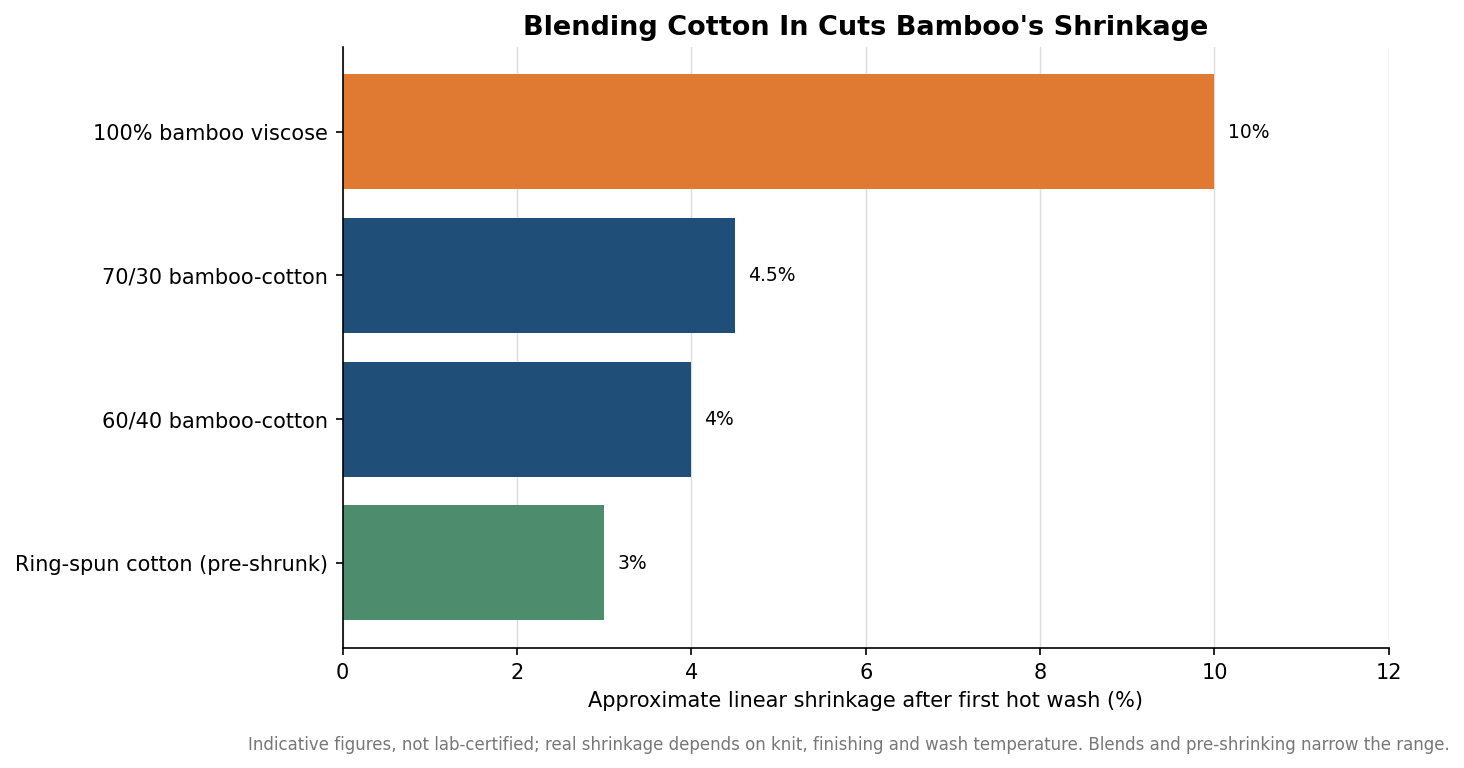
    The most common complaint about pure bamboo viscose is dimensional change. A 100 percent viscose tee can lose close to 10 percent of its length in a hot wash if it has not been aggressively pre-shrunk, which is enough to turn a large into a medium. Blending cotton in tightens that up considerably, with 60/40 and 70/30 bamboo-cotton constructions typically settling into the 3 to 5 percent range, comparable to a decent pre-shrunk cotton tee. Bamboo also has almost no natural spring-back, so garments meant to stretch and recover, like fitted athletic shirts, usually add 5 to 10 percent elastane for that job. The figures below are indicative rather than lab-certified, because real shrinkage depends on the specific knit, the finishing, and how hot the customer washes, but the direction is reliable: blends and pre-shrinking narrow the range.

    Horizontal bar chart of indicative first-wash shrinkage by fabric construction, showing 100 percent bamboo viscose near 10 percent and bamboo-cotton blends near 4 percent
    Blending cotton into bamboo and pre-shrinking the fabric brings shrinkage close to a standard cotton tee.

    Care instructions matter more with bamboo than with cotton, and it is worth printing them clearly. Cold or warm washing, gentle detergent, and low or no heat drying keep the fabric stable and preserve the softness that made someone choose bamboo in the first place. High dryer heat is the fastest way to both shrink the garment and dull the print.

    Choosing the right blank for your run

    For a soft, premium feel where drape and comfort sell the shirt, a bamboo-cotton blend around 160 to 190 GSM is a strong default, and it prints predictably enough for most logos and mid-detail designs. For photographic or fine-line art, a high-cotton blend or combed ring-spun cotton gives the cleanest result. For athletic or fitted cuts, look for a bamboo blend with spandex and expect to pay more per unit. Ask the mill or supplier for the exact fiber content, the GSM, whether the fabric is pre-shrunk, and whether it carries a certification such as OEKO-TEX Standard 100, which verifies the finished cloth is free of harmful residues. Those four numbers tell you far more about how your custom order will turn out than the word bamboo on its own. When possible, order a blank sample and run a test print and a hot wash before committing to a large quantity, because the gap between a good bamboo tee and a disappointing one comes down to construction details that only show up after the first laundry cycle.