Ordering custom shirts means choosing a blank before you choose a design, and the fabric decision quietly controls how the finished garment feels, how the print holds up, and how the shirts fit after a few washes. Bamboo-based tees have moved from novelty to mainstream, and buyers now weigh them directly against the cotton blanks that have dominated printing for decades. The two behave differently enough that the right choice depends on what you are printing, how the shirts will be worn, and how much you care about drape versus durability.
What “bamboo fabric” actually means
The word bamboo on a hangtag almost always describes a regenerated cellulose fiber rather than a fabric spun from bamboo stalks. Industry estimates put more than 80 percent of bamboo apparel in the bamboo viscose (rayon) category, made by dissolving bamboo pulp in a chemical bath and extruding it into filaments. The result is exceptionally soft, drapey, and highly absorbent, with excellent dye uptake. A more premium route is bamboo lyocell, produced in a closed-loop system that recovers roughly 99 percent of the solvent and yields better wet strength and less pilling. A third, far rarer version is mechanically processed bamboo linen, which crushes and enzyme-treats the stalk to produce a textured, linen-like cloth. For printing purposes, most of what you will handle is viscose or a viscose-cotton blend.
One labeling detail is worth knowing before you market the shirts. In the United States, the Federal Trade Commission treats chemically regenerated bamboo as rayon and requires it to be labeled that way, typically as “rayon” or “rayon made from bamboo.” The agency has penalized retailers for calling the same fabric simply “bamboo” or for repeating unverified antibacterial and eco claims. If you resell printed bamboo tees, mirror the mill’s fiber content on your own listings rather than upgrading the language.
Weight and feel: reading the GSM number
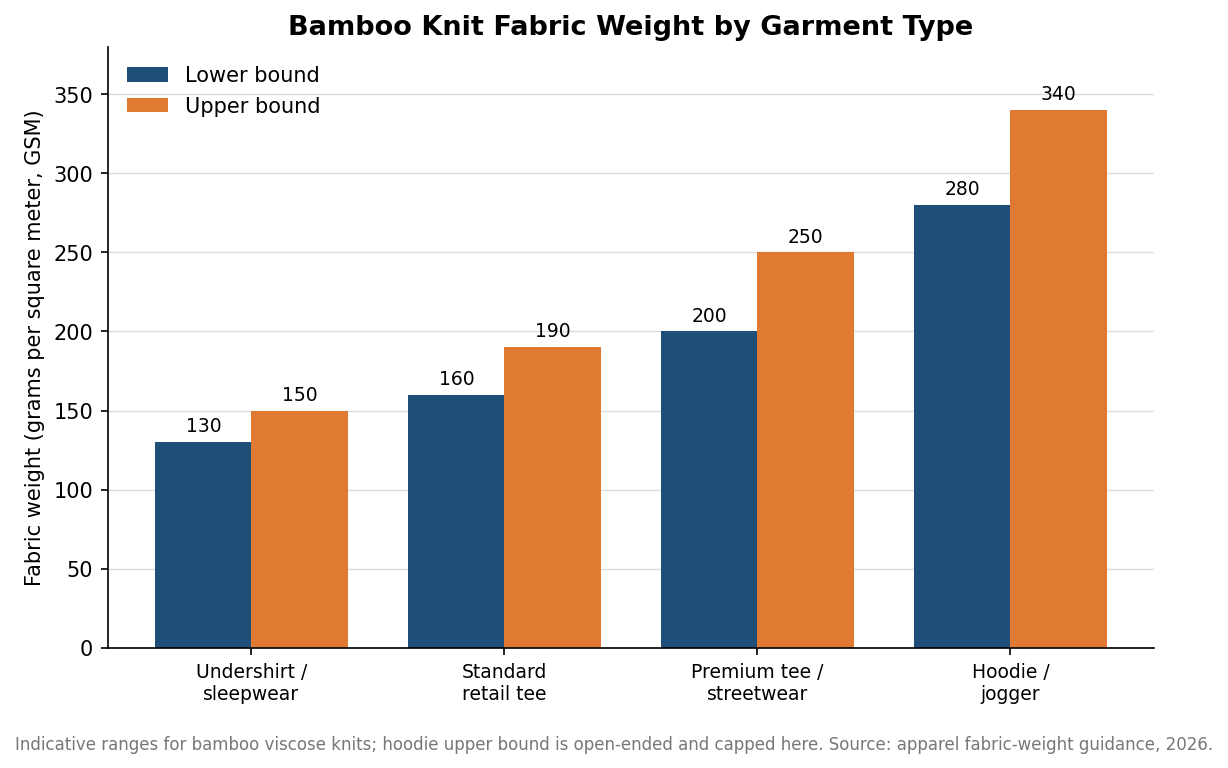
Fabric weight, quoted in grams per square meter (GSM), tells you more about a shirt than the fiber name alone. Lightweight knits in the 130 to 150 GSM band suit undershirts and sleepwear but can feel thin and show print backing through the cloth. The sweet spot for a standard retail-quality tee sits around 160 to 190 GSM, heavy enough to feel substantial and to support a clean print, light enough to keep bamboo’s signature drape. Premium tees and streetwear push into 200 to 250 GSM, and anything at 280 GSM or above is really hoodie and jogger territory. Bamboo viscose reads softer and cooler than cotton at the same weight because the fiber is smoother and more absorbent, so a 180 GSM bamboo blend often feels lighter on the body than a 180 GSM all-cotton tee.
How bamboo takes a print
Cotton remains the default for printing because combed ring-spun cotton gives a flat, fine surface that both screen printing and direct-to-garment (DTG) inks sit on crisply, holding sharp edges and photographic detail. Bamboo viscose can take an excellent print too, but it rewards a printer who adjusts for it. The fiber is smooth and slightly slick, so DTG work generally needs proper pretreatment and a careful cure, and screen printers often favor bamboo-cotton blends over pure viscose because the cotton content gives the ink more tooth to grab. Blends in the 60/40 to 70/30 range are the practical compromise: they keep much of bamboo’s hand while printing closer to the way a cotton tee does. If your artwork is a bold one- or two-color logo, almost any construction will work; if it is a detailed full-color image, a combed-cotton or high-cotton blend is the safer surface.
Embroidery is a separate question from ink. Stitching needs a stable, midweight-to-heavy base, generally 180 GSM and up, or the fabric puckers around dense designs. Lightweight bamboo knits under that threshold are better matched to a printed logo than to a large embroidered crest.
Shrinkage, stretch, and blends
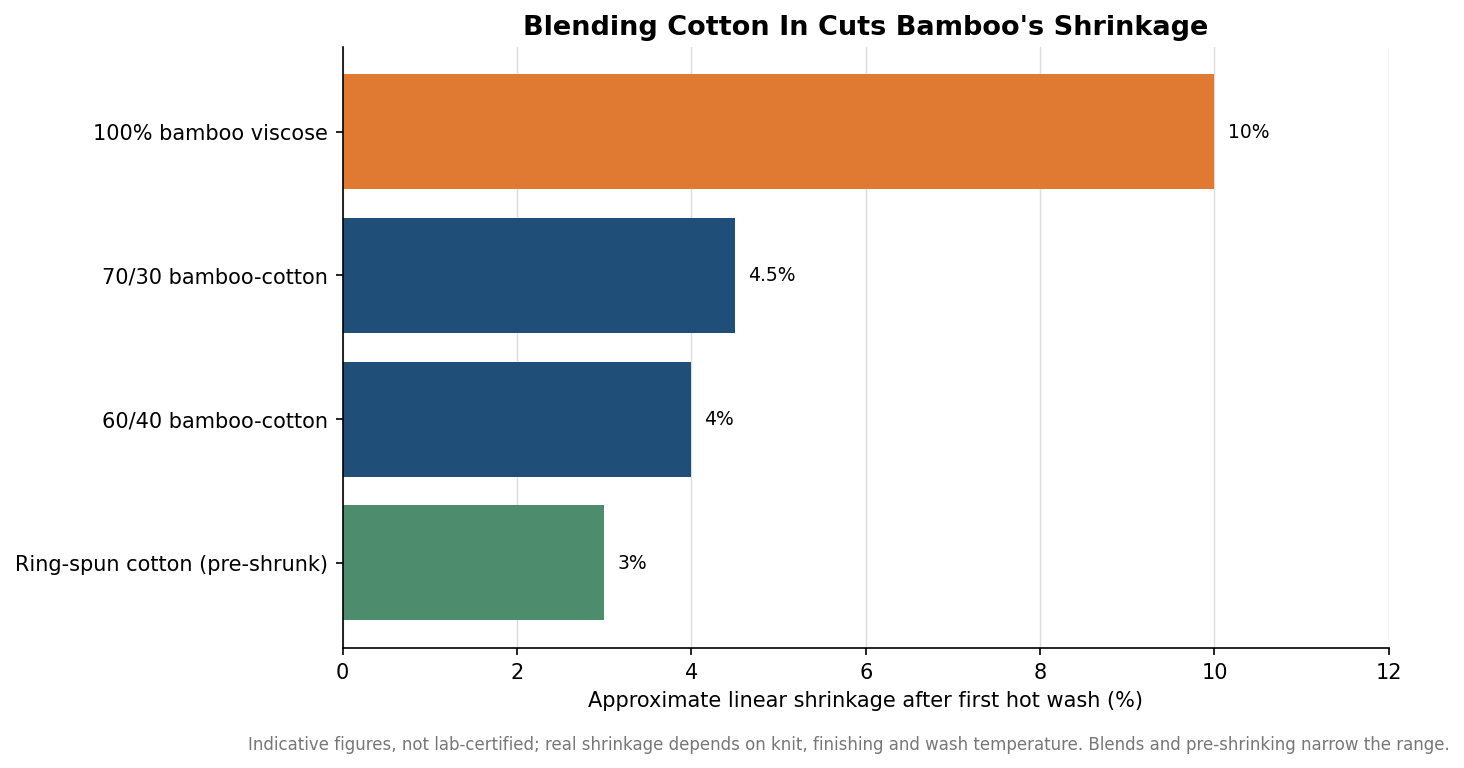
The most common complaint about pure bamboo viscose is dimensional change. A 100 percent viscose tee can lose close to 10 percent of its length in a hot wash if it has not been aggressively pre-shrunk, which is enough to turn a large into a medium. Blending cotton in tightens that up considerably, with 60/40 and 70/30 bamboo-cotton constructions typically settling into the 3 to 5 percent range, comparable to a decent pre-shrunk cotton tee. Bamboo also has almost no natural spring-back, so garments meant to stretch and recover, like fitted athletic shirts, usually add 5 to 10 percent elastane for that job. The figures below are indicative rather than lab-certified, because real shrinkage depends on the specific knit, the finishing, and how hot the customer washes, but the direction is reliable: blends and pre-shrinking narrow the range.
Care instructions matter more with bamboo than with cotton, and it is worth printing them clearly. Cold or warm washing, gentle detergent, and low or no heat drying keep the fabric stable and preserve the softness that made someone choose bamboo in the first place. High dryer heat is the fastest way to both shrink the garment and dull the print.
Choosing the right blank for your run
For a soft, premium feel where drape and comfort sell the shirt, a bamboo-cotton blend around 160 to 190 GSM is a strong default, and it prints predictably enough for most logos and mid-detail designs. For photographic or fine-line art, a high-cotton blend or combed ring-spun cotton gives the cleanest result. For athletic or fitted cuts, look for a bamboo blend with spandex and expect to pay more per unit. Ask the mill or supplier for the exact fiber content, the GSM, whether the fabric is pre-shrunk, and whether it carries a certification such as OEKO-TEX Standard 100, which verifies the finished cloth is free of harmful residues. Those four numbers tell you far more about how your custom order will turn out than the word bamboo on its own. When possible, order a blank sample and run a test print and a hot wash before committing to a large quantity, because the gap between a good bamboo tee and a disappointing one comes down to construction details that only show up after the first laundry cycle.